



If you want to receive Grounded in the Bible’s Bible studies directly in your inbox, you can subscribe here! Join us as we “grow in the grace and knowledge of our Lord and Savior Jesus Christ.”
Have you ever sat and tried to wrap your head around who God is? No matter how much we study and learn about God, we always discover something that shifts our thinking. This has happened to me as I’ve continued to build my Characteristics of God library of studies.
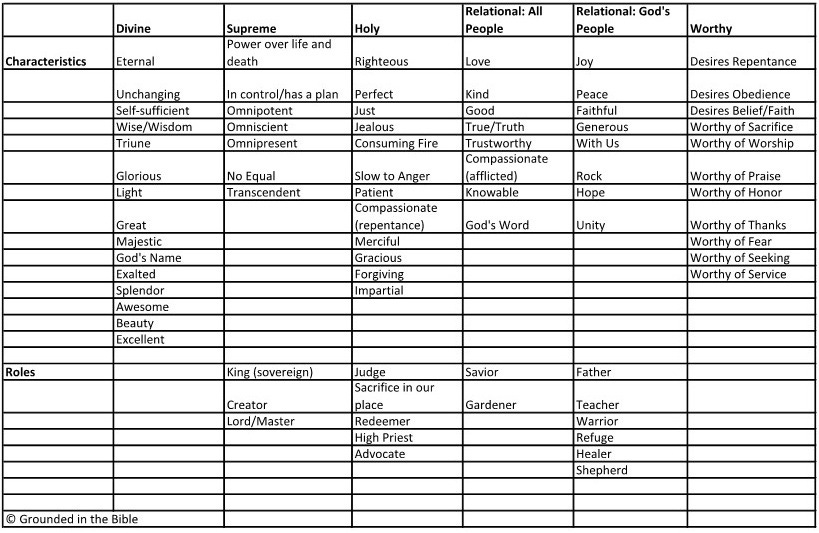
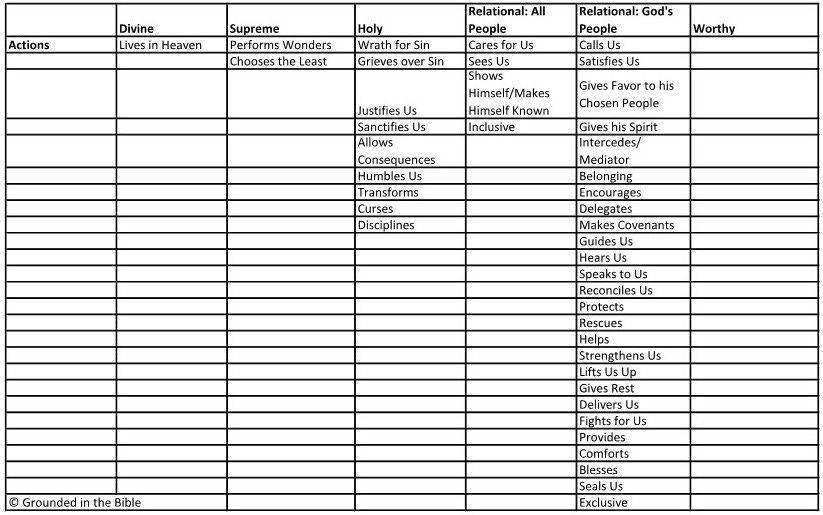
As I mentioned in my previous post, God has given me the task of creating a comprehensive index and commentary on the characteristics, roles, and actions of God in the Bible. As I’ve continued to sit with this thought, and as I’ve continued my study, I’ve decided to rearrange the characteristics that I had previously into something that better aligns with what I’m learning. I’ve also added several characteristics, going from about 70 to almost 120.
First, instead of calling everything a “characteristic,” I’ve assigned each item as a characteristic (God is loving), a role (God is Father), or an action (God guides us). Granted, some of these could be put into more than one category. For example, God is forgiving (characteristic), God is the ultimate forgiver (role), or God forgives (action). In these cases, I just picked the category I thought fit it best, because ultimately my labeling each one as a characteristic, role, or action will not change who God is or how I approach the study for that item. And I’ll probably still generally call them all “characteristics” just for simplicity.
Second, I rearranged how I decide which group each characteristic fits into. These are now my groups:
Who God is within himself. These characteristics show who God is apart from his creation. The primary characteristic in this group is God is Divine.
Who God is in relation to his creation. These characteristics show who God is in relation to all of his creation, including humans, plants, animals, planets, and everything else. The primary characteristic in this group is God is Supreme.
Who God is in relation to sin. These characteristics show how God interacts with people who have sinned, both repentant and unrepentant. The primary characteristic in this group is God is Holy.
Who God is in relation to all people. These characteristics show how God interacts with his most precious creation, people, regardless of whether or not they follow him. The primary characteristic in this group is God is Relational (All People).
Who God is in relation to His people. These characteristics show God’s special care for the people who choose to follow him. The primary characteristic in this group is God is Relational (His People).
How God wants people to respond to him. These characteristics show us how God wants people to interact with him. What does he desire of us? What is he worthy of? The primary characteristic in this group is God is Worthy.
Similar to the categories of characteristic, role, or action, some characteristics fit under more than one of these groups. For example, God is Holy could go with “Who God is within himself” and “Who God is in relation to sin.” When this happens, I try to put it in the category that seems most specific for that characteristic.
Third, I’ve decided to include characteristics that are more specific to Jesus and the Holy Spirit instead of only God the Father or all three in general. I may eventually split these off into a separate category, but I haven’t done that quite yet.
Given those things, the tables below shows my most recent list of characteristics, roles, and actions of God. Subject to change as I continue my study.
I hope you continue to come along on the journey as we learn more about the characteristics, roles, and actions of God. I’m currently working on the study for God Delivers Us, and then I plan to work on God’s Name, which has always intrigued me. If you have a specific characteristic you would like me to prioritize in my study, feel free to drop me a note! Or if you have a characteristic that I don’t have listed here, I’d love to hear about that too.
If you want to download a PDF version of the tables above for your own study, you can do that here:
